
Uncategorized
Live Resin Sugar vs. Other Concentrate Formats
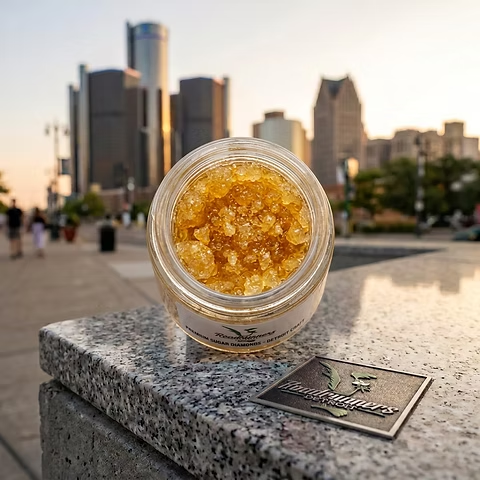
Aug
Live Resin Sugar vs. Other Concentrate Formats: What’s the Difference?
Live resin sugar vs. other concentrate formats isn’t simply a comparison of which product is stronger or more premium.
Cannabis concentrates can differ in several fundamental ways: the condition of the plant when processing begins, the extraction method, the amount of post-processing, the resulting consistency, and the balance of cannabinoids and aromatic compounds in the finished product.
Live resin sugar occupies an interesting position because its name tells you two different things.
“Live resin” refers to a concentrate produced from cannabis preserved through freezing soon after harvest rather than first being conventionally dried and cured.
“Sugar” describes its semi-crystalline consistency, which commonly resembles wet or coarse sugar suspended in a more fluid concentrate fraction.
That makes live resin sugar different from rigid shatter, whipped badder, dry crumble, crystal-heavy diamonds, solventless rosin, and highly refined distillate.
Understanding those differences makes choosing between concentrates considerably easier.
What Is Live Resin Sugar?
Live resin sugar is a live resin concentrate with a granular or semi-crystalline consistency.
Its appearance can resemble small cannabinoid-rich crystals surrounded by a softer, terpene-containing fraction.
The “live” portion of the name comes from the starting material.
Instead of allowing harvested cannabis to go through the conventional drying and curing process before extraction, material intended for live resin is preserved through freezing soon after harvest.
The objective is to retain more of the volatile compounds that can change or diminish during post-harvest drying and curing.
The “sugar” portion describes what happens to the concentrate’s physical structure.
Rather than remaining completely homogeneous or forming a rigid glass-like sheet, components of the extract crystallize and produce the characteristic granular texture.
So:
Live = starting-material/process category
Resin = extracted cannabis concentrate
Sugar = consistency
Keeping those concepts separate makes the rest of the concentrate market much easier to understand.

Is Live Resin Sugar the Same as Sugar Wax?
Not necessarily.
The terms are sometimes used loosely, but there is an important distinction.
Sugar or sugar wax describes a concentrate consistency. Sugar can be produced from material that was dried and cured before extraction.
Live resin sugar specifically indicates that the concentrate belongs to the live-resin category, meaning fresh-frozen cannabis was used as the starting material.
Both can have a similar granular appearance.
The difference is not established by texture alone.
When evaluating a product, rely on its documented concentrate type rather than assuming every sugar-like extract is live resin.
Why Does Live Resin Turn Into a Sugar-Like Texture?
Cannabis concentrates contain different compounds that don’t always remain in one perfectly uniform structure.
Under suitable processing and storage conditions, cannabinoid components can begin forming crystals while a more fluid fraction remains around them.
This creates the recognizable sugar-like appearance.
Processing variables influence the final consistency, including:
-
Temperature
-
Pressure
-
Agitation
-
Cannabinoid composition
-
Terpene content
-
Moisture
-
Storage conditions
-
Post-extraction handling
This is why two concentrates originating from similar material can ultimately look very different.
Texture is partly a product of chemistry and processing—not automatically a quality ranking.

Live Resin Sugar vs. Other Concentrates at a Glance
| Concentrate | Typical Consistency | Starting Material / Process Distinction | Key Characteristic |
|---|---|---|---|
| Live resin sugar | Granular, wet-sugar-like | Fresh-frozen cannabis; extracted | Combines live-resin processing with sugar consistency |
| Shatter | Hard, brittle, glass-like | Commonly solvent-extracted | Stable rigid structure |
| Badder/Budder | Soft, whipped, creamy | Process varies | Easy-to-work soft consistency |
| Crumble | Dry, porous, crumbly | Extract with texture-specific post-processing | Breaks apart easily |
| Live resin sauce | Fluid/saucy, sometimes crystalline | Fresh-frozen cannabis | More liquid consistency |
| Diamonds | Large crystalline structures | Controlled crystallization | Crystal-dominant format |
| Rosin | Varies from sap-like to badder-like | Heat and pressure | Solventless extraction |
| Distillate | Thick oil | Highly refined/distilled extract | Cannabinoid-focused refinement |
These categories aren’t always mutually exclusive.
For example, live resin can appear as sugar, sauce, badder, or other consistencies depending on how it is processed.
That’s why understanding both extraction method and texture is more useful than judging concentrates by appearance alone.
Live Resin Sugar vs. Shatter
Shatter is one of the easiest concentrates to distinguish visually from sugar.
Texture
Live resin sugar: granular, crystalline, and relatively soft.
Shatter: thin, hard, and glass-like when stable at typical handling temperatures.
The name “shatter” comes from its tendency to snap or break into pieces.
Processing
Shatter is commonly produced through solvent-based extraction followed by controlled post-processing designed to maintain its relatively uniform, glass-like structure.
Live resin sugar differs because the starting cannabis is preserved through freezing and the finished concentrate develops a crystalline sugar consistency.
Handling
Shatter’s rigid structure can make it relatively straightforward to break into portions when maintained under suitable conditions.
Sugar behaves more like a granular concentrate and is generally scooped rather than snapped.
Flavor and Aroma
A concentrate being “shatter” doesn’t automatically tell you whether it was produced from fresh-frozen or cured material.
Live resin sugar, by definition, belongs to the live-resin category and therefore places greater emphasis on preserving characteristics of fresh-frozen starting material.
Which Is Better?
Neither consistency is universally better.
Choose based on whether you prioritize a rigid, stable texture or specifically want the characteristics associated with a live-resin sugar format.
Live Resin Sugar vs. Badder and Budder
Badder and budder sit much closer to live resin sugar in terms of softness, but their physical structures are noticeably different.
Live Resin Sugar
Sugar has visible granularity.
Its texture may contain small crystalline structures surrounded by a softer or saucier fraction.
Badder
Badder generally has a softer, whipped consistency resembling thick batter or frosting.
Budder
Budder tends toward a smooth, creamy, butter-like consistency and can be somewhat firmer than very soft badder.
The terminology isn’t perfectly standardized across every producer, so visual and product-specific information still matter.
The Practical Difference
The biggest difference is handling.
Badder and budder can be smooth and cohesive on a concentrate tool.
Sugar is more granular.
That doesn’t automatically mean one has higher THC, greater purity, or better quality.
Consistency alone can’t establish those things.
Live Resin Sugar vs. Crumble
Crumble gets its name from its dry, breakable texture.
It typically has a porous or honeycomb-like structure that breaks apart relatively easily.
Live resin sugar generally retains a wetter, more granular appearance.
Think:
Sugar → moist, crystalline granules
Crumble → drier, porous pieces
This difference can influence handling and storage, but it shouldn’t be treated as a direct measure of potency.
Two products with very different textures can still have cannabinoid results that depend entirely on their respective batches.
Live Resin Sugar vs. Live Resin Sauce
This comparison demonstrates why live resin is not one single consistency.
Both products can begin with fresh-frozen cannabis and belong to the live-resin category.
Their final physical structures differ.
Live Resin Sugar
Has a more pronounced granular or crystalline structure.
Live Resin Sauce
Has a more fluid, sauce-like consistency and may contain crystalline material depending on the product.
The distinction therefore isn’t:
live resin vs. non-live resin
It’s largely:
one live-resin consistency vs. another live-resin consistency.
For buyers, this can make handling preference particularly important.
Live Resin Sugar vs. Diamonds
Cannabis diamonds are crystalline structures dominated by cannabinoid acids such as THCA in products where that compound is present.
They are visually distinct because individual crystals can become considerably larger than the fine granules associated with sugar.
A simplified comparison is:
Sugar: numerous smaller crystalline structures mixed throughout a softer concentrate.
Diamonds: larger, more distinct crystalline structures, sometimes paired with a terpene-rich sauce.
The presence of visible crystals shouldn’t be used to guess exact potency.
Laboratory analysis is required for product-specific cannabinoid information.
What About Diamonds and Sauce?
Diamonds may be presented with a liquid concentrate fraction often called sauce.
This combines larger crystalline structures with a more fluid component.
Live resin sugar tends to have a more integrated, granular consistency rather than a pronounced separation between large crystals and sauce.
Live Resin Sugar vs. Rosin
This is one of the most important comparisons because resin and rosin are frequently confused.
They are not interchangeable terms.
Live Resin
Live resin is generally produced using an extraction solvent in professional processing equipment, with fresh-frozen cannabis as the starting material.
Rosin
Rosin is produced mechanically using heat and pressure, without hydrocarbon extraction solvents.
Rosin can be made from flower or hash.
Live Rosin
Live rosin generally begins with fresh-frozen cannabis that is first processed into hash. That hash is then pressed using heat and pressure.
So:
Live resin: fresh frozen → extraction → concentrate
Live rosin: fresh frozen → hash production → heat-and-pressure pressing → concentrate
Both may emphasize preservation of characteristics associated with fresh material, but they reach the finished product through different extraction pathways.
For a deeper explanation of solventless hash and rosin production, read our How Whole Melt Extract Is Made guide.
Live Resin Sugar vs. Distillate
Distillate represents a substantially different concentrate philosophy.
Live resin generally aims to retain a broader representation of compounds associated with the source material.
Distillation, by contrast, involves extensive refinement designed to isolate and concentrate particular compounds.
That means distillate and live resin shouldn’t be compared only by THC percentage.
Live Resin Sugar
Emphasizes the characteristics of a live-resin extract and retains a textured, semi-crystalline form.
Distillate
Is highly refined and usually has a thick, oil-like consistency.
Distillation can remove much of the original aromatic profile, and formulations may subsequently incorporate terpenes depending on the product.
Neither label by itself establishes quality.
The appropriate comparison depends on what the buyer values and what verified product information is available.
Live Resin Sugar vs. Traditional Whole-Melt Hash
These products differ at the extraction level.
Traditional whole-melt hash is associated with mechanical trichome separation, commonly through ice-water processing or dry sifting.
Live resin sugar is an extracted concentrate made from fresh-frozen cannabis.
The pathways therefore differ:
Whole-melt hash:
Cannabis → mechanical trichome separation → filtration → drying → hash
Live resin sugar:
Fresh-frozen cannabis → controlled extraction → solvent removal/post-processing → crystallization → sugar consistency
This distinction matters on a Whole Melt Extracts website because the brand name shouldn’t be confused with the technical definition of traditional whole-melt hash.
Different Whole Melt product families can represent different concentrate formats.
Does Live Resin Sugar Have More Terpenes Than Other Concentrates?
Avoid treating this as a universal rule.
Live-resin processing is designed around fresh-frozen starting material and is associated with preserving volatile aromatic compounds that can be lost or altered during drying and curing.
But that doesn’t mean every live resin sugar contains more terpenes than every shatter, badder, rosin, or other concentrate.
Actual terpene content depends on the product and batch.
Factors include:
-
Starting material
-
Cultivar
-
Extraction
-
Post-processing
-
Storage
-
Temperature exposure
-
Packaging
-
Time
If terpene content matters, use relevant product or batch laboratory information rather than assuming it from consistency.
Is Live Resin Sugar Stronger Than Shatter or Wax?
Not automatically.
Texture isn’t a potency scale.
Sugar looking crystalline doesn’t establish a specific cannabinoid percentage.
Likewise:
Shatter ≠ automatically stronger
Diamonds ≠ automatically strongest
Live resin ≠ fixed THC percentage
Rosin ≠ fixed potency
Cannabinoid concentration should be determined from relevant laboratory results for the specific product or batch.
This is much more reliable than choosing concentrates based on generalized online potency claims.
Does Concentrate Color Indicate Quality?
Color can provide visual information, but it isn’t a universal quality grading system.
Concentrates can range from lighter yellow and gold tones to deeper amber shades depending on numerous factors.
These can include:
-
Starting material
-
Plant maturity
-
Extraction
-
Processing
-
Storage
-
Oxidation
-
Product type
A darker concentrate isn’t automatically bad.
A pale concentrate isn’t automatically premium.
And color cannot establish authenticity, cannabinoid content, or contaminant status.
Those conclusions require better evidence.
Which Concentrate Is Easiest to Handle?
Texture makes a meaningful difference here.
Live Resin Sugar
Granular consistency generally works naturally with a concentrate tool.
Shatter
Rigid pieces can be relatively easy to portion while cool and stable, although warmth may make shatter softer or stickier.
Badder/Budder
Soft consistency makes these products easy to scoop but potentially more adhesive.
Crumble
Dry texture makes it easy to separate, though small pieces can break apart.
Sauce
Fluid consistency requires more careful handling.
Diamonds
Larger crystals can be physically straightforward to separate, depending on whether they’re suspended in sauce.
Rosin
Handling varies significantly because rosin can be produced in several consistencies.
There is no universal winner.
Choose according to the handling characteristics you prefer.
How Storage Affects Different Concentrates
Cannabis concentrates continue changing after production.
Heat, light, oxygen, and unnecessary exposure can affect aroma, consistency, and stability.
This is especially important for softer and terpene-rich concentrates.
As a general principle:
-
Keep containers securely closed.
-
Limit unnecessary exposure to air.
-
Protect concentrates from excessive heat.
-
Avoid prolonged direct sunlight.
-
Follow product-specific storage instructions.
-
Keep cannabis products securely away from children and pets.
Different concentrate formats may respond differently to temperature.
Shatter can soften.
Badder can dry out.
Sauce can become more difficult to handle.
Sugar can change consistency.
The fact that a concentrate’s texture changes over time does not by itself establish that it is counterfeit.
What Should You Compare Before Choosing a Concentrate?
Don’t start with the question:
“Which one is best?”
Start with:
“What characteristics matter to me?”
| Your Priority | Formats Worth Comparing |
|---|---|
| Granular, scoopable consistency | Live resin sugar / sugar |
| Rigid, breakable texture | Shatter |
| Soft, creamy handling | Badder / budder |
| Dry, crumbly handling | Crumble |
| Fluid consistency | Sauce |
| Large crystalline structures | Diamonds |
| Solventless processing | Rosin / hash rosin |
| Highly refined cannabinoid concentrate | Distillate |
| Fresh-frozen starting material | Live resin / live rosin |
This doesn’t declare one product superior.
It helps you identify which category actually matches what you’re looking for.
How to Evaluate Whole Melt Live Resin Sugar
When comparing a Whole Melt live resin sugar product, don’t judge it solely by appearance.
Review the complete product information.
Consider:
-
Product name
-
Concentrate format
-
Flavor or strain profile
-
Package quantity
-
Product or batch information
-
Available laboratory documentation
-
Packaging integrity
-
Verification information
-
Seller credibility
Our store provides 100% authentic products, independent lab testing, and product-verification support.
If authenticity is a concern, use our Whole Melt Extracts Verification Guide rather than attempting to determine authenticity from concentrate color or texture alone.
Live Resin Sugar Buying Mistakes to Avoid
Assuming “Live” Means Stronger
“Live” refers to the handling of the plant material used for the concentrate, not a guaranteed potency level.
Confusing Live Resin With Live Rosin
Their names are similar, but their extraction methods differ.
Assuming Crystals Automatically Mean Higher THC
Visible crystal structure cannot provide an exact cannabinoid result.
Choosing Entirely by Color
Color alone isn’t a reliable quality measurement.
Assuming Every Sugar Is Live Resin Sugar
Sugar describes consistency. Live resin adds information about the starting material and processing category.
Ignoring the COA
When relevant laboratory documentation is available, it provides more meaningful product-specific information than appearance alone.
Treating Texture as a Quality Ranking
Shatter, badder, sugar, crumble, sauce, and other consistencies are different formats—not a simple worst-to-best ladder.
Live Resin Sugar Comparison Checklist
Before choosing between live resin sugar and another concentrate, ask:
-
Do I understand how the concentrate was produced?
-
Was fresh-frozen or cured material used?
-
Is the product solvent-based or solventless?
-
What consistency do I prefer?
-
How easy is that consistency for me to handle?
-
Am I looking for live-resin characteristics specifically?
-
Have I reviewed relevant product information?
-
Is batch-specific laboratory documentation available?
-
Can the product be verified?
-
Do I understand the appropriate storage requirements?
These questions are more useful than simply comparing which concentrate has the most premium-sounding name.
Frequently Asked Questions
What is live resin sugar?
Live resin sugar is a cannabis concentrate made from fresh-frozen starting material that develops a semi-crystalline, granular consistency resembling wet sugar. “Live resin” describes the concentrate category and starting-material approach, while “sugar” describes its texture.
What is the difference between live resin sugar and regular sugar wax?
Both can have similar granular consistencies. The important distinction is that live resin sugar is made from fresh-frozen cannabis, while sugar concentrates can also be made from dried and cured material.
Is live resin sugar better than shatter?
Neither is universally better. Live resin sugar has a softer, granular consistency and belongs to the live-resin category, while shatter is characterized by its rigid, glass-like structure. Your preference may depend on handling, product characteristics, and verified product information.
Is live resin sugar stronger than badder?
Not necessarily. Sugar and badder describe different consistencies, and texture alone doesn’t establish potency. Compare laboratory results associated with the specific products or batches.
Is live resin sugar the same as live rosin?
No. Live resin is generally produced through solvent-based extraction of fresh-frozen cannabis. Live rosin is produced by creating hash from fresh-frozen material and then mechanically pressing that hash using heat and pressure.
What’s the difference between live resin sugar and diamonds?
Sugar generally contains smaller crystalline structures distributed through a softer concentrate fraction. Diamonds contain larger, more distinct cannabinoid crystals and may be presented with sauce. Neither appearance alone determines exact potency.
Does live resin sugar have more flavor than other concentrates?
Live-resin processing is associated with preserving volatile compounds from fresh-frozen material, which can support an expressive aromatic profile. However, actual terpene content varies by product and batch, so live resin sugar shouldn’t automatically be assumed to contain more terpenes than every other concentrate.
How should live resin sugar be stored?
Protect the concentrate from excessive heat, direct light, unnecessary air exposure, and other conditions that can affect its consistency and aromatic profile. Keep the container securely closed and follow any product-specific storage instructions.
Live Resin Sugar vs. Other Concentrates: Which Format Makes Sense?
The biggest lesson from comparing live resin sugar vs. other concentrate formats is that concentrate names tell you different things.
Some describe processing.
Some describe starting material.
Others primarily describe texture.
Live resin sugar combines two of those ideas: fresh-frozen material associated with live-resin production and a semi-crystalline sugar consistency.
Shatter offers a rigid texture. Badder and budder are softer and whipped. Crumble is drier. Sauce is more fluid. Diamonds emphasize larger crystalline structures. Rosin uses a fundamentally different solventless production route. Distillate emphasizes extensive refinement.
None of those labels alone tells you which product is objectively best.
Understanding what each term actually means—and then checking the specific product, batch information, laboratory documentation, and verification details—gives you a much better basis for choosing.
Want to explore the concentrate lineup? Browse our Whole Melt Extracts Live Resin Sugar collection, or review our Whole Melt Extracts Verification Guide before making your selection.
